
Oikos
Oi
kos
Dwelling, family, the culture of living
a perfect balance between
who we are and what surrounds us.

Home comfort and healthiness: a possible utopia

1
We spend most of our life-about 90% according to EPA (Environmental Protection Agency)- inside buildings. Our days are wasted between domestic walls, offices, schools and care centers. Homes, in particular, are the stage for our everyday intimacy, but we rarely stop on thinking to their most essential and invisible quality: healthiness.
 
A healthy home is not only a conformable place, well-furnished or energy-efficient. It is first a living organism that breathe with us, that welcomes and supports us, and that does not poison us. It is a space that protects our psychophysical well-being and respects the surrounding environment.
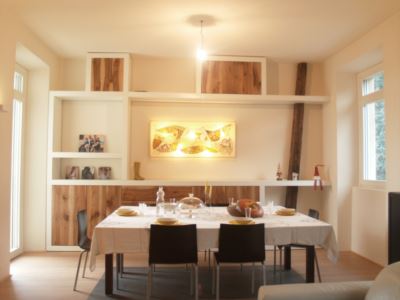
 
Residential comfort -this word this seemingly technical yet profoundly philosophical term - encompasses multiple dimensions, many of which are hard to quantify. Comfort is not only a ideal temperature, clean air or natural light: it also is subjective satisfaction, metal calm, harmony with one’s space. As the philosopher Gaston Bachelard noted in The Poetics of Space, the home is “one of the strongest powers of integration for man’s thoughts, memories, and dreams.” But what happens when this power  breaks, and the house becomes a place of discomfort?
 
As early as 1984, the World Health Organization estimated that the 30% of newly built houses had indoor air quality issues. In this context the term “sick building syndrome” emerged: a transient  but insidious condition, in which occupants experience symptoms (headaches, irritation, fatigue) that vanish upon leaving the environment.
Many homes show concerning concentrations of Volatile Organic Compounds (VOCs)—easily evaporating molecules released from paints, adhesives, furnishings, building materials—making indoor air up to five times more polluted than the outdoor air.
 
Residential well-being unfolds across five key dimensions: thermal-hydrometrical, linked to temperature and humidity: hygienic, linked to air quality and absence of mold or harmful substances; visual, about natural and artificial light; acoustic, that protect from noise and promote silence; psychological, that invest in personal and cultural relationship with one’s space.
 
For instance, thermal perception comfort depends on precise parameters: indoor air temperature should range between 18°C and 22°C in winter and around 26°C in summer: relative humidity lies between the 40% and 60%. Yet, even these figures alone don’t’ guarantee well-being. Heat or cold infiltrates in our thoughts differently depending on season, cultural habits, and mood. Overly dry or humid environment can foster mold growth, especially if accompanied by poorly resolved thermal bridges or inadequate ventilation.
1

Home as a den, nest, refuge

To build or renovate in a healthy way, we need to think the home such as an ecosystem in balance, where materials, systems and technologies interact with the physiological and symbolic needs of inhabitants. We need a new education on living, one that combines scientific knowledges and ethical sensibility. A wisdom that doesn’t stop at efficiency, but aims at care: for the house, the body and the mind.
 
In an era increasingly focused on sustainability, it’s worth remembering the first form of sustainability, starts where we lay our heads every night. The home gives back what we give to it. If it is alive, it keeps us alive. If it is sick, it makes us sick.