Oikos
Oi
kos
Dwelling, family, the culture of living
a perfect balance between
who we are and what surrounds us.

Building with straw

1
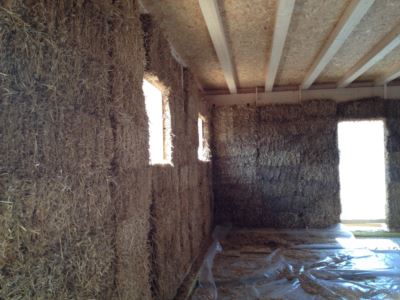
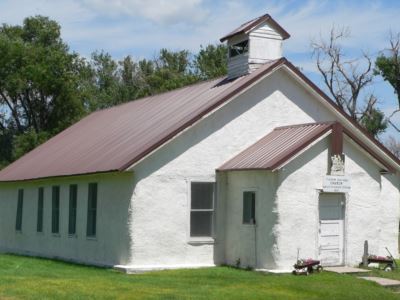
We are Nebraska, United States, in the second half of 19th Century: colonists needed home.  There were desolated places, without forests or vegetation and without stones or wood for building. The only one abundant resource comes from the main source of income: wheat straw, harvested and compacted into modular bales. 
 
Settlers began using these agricultural by-products which turns out to be a good material for building not just temporary shelters, but long-term homes.
 
When we talk about straw, popular culture is certainly not on our side: we all know the tale of Three Little Pigs, published for the first time by James Orchard Halliwell-Phillipps in the collection of fairy tales Nursery Rhymes and Nursery Tales and made famous by countless transpositions. The tale, as Italo Calvino remember us in his “Fiabe Italiane”, has very ancient origins and a long oral Tradition and has found various local and regional versions over the centuries. Change characters, change places, but the narrative structure remains the same: particular, the first shelter capable of being swept away with a single breath by the wolf is precisely the one made if straw (or leaves or brushwood, depending on the version). 
 
Although, homes built with bales straws used such as bricks to realize leading walls without the wood frame (a technique later renamed Nebraska) still exist, more than 150 years after their construction, and straw proves to be a building material with surprising features.
1
 Let's go back to the beginning of this story, to the houses of Nebraska in the late 19th century: from America, within a few decades this technique was successfully exported to the Old Continent.
 
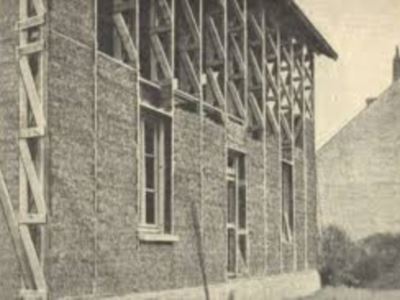
In 1921, to overcome the lack of materials and economics resources after the Great War, the engineer Émile Feuillette used straw bales to build the Maison Feuillette a Montargis, in France, 90km from Paris, the first example of two-story building in the world which still exist today.
 
Popularity of straw bales such a construction material was stopped, but soon returned, dictated by the same rules that had decreed their success in Nebraska: the need to make a virtue of lack (of materials, economic resources, energy resources).
 
In the 1970’s, the use of straw as a construction material means building homes more efficient. In Europe, the development of these residential buildings began in 1989 in the United Kingdom, after spreading to Norway, France, and, over time, in Switzerland and Austria. This movement arose primarily from homeowner’s desire to embrace environmentalist ideals, but also, in some cases, from the search for low-cost materials and the passion for self-building that drives end users themselves. 
1
Today, building straw bales houses is gaining more and more popularity.
 
The main reasons of this success can be summarized in several aspects: the choice to adopt a more sustainable lifestyle through green building, the desire to use natural materials, the preference for living in rural settings, the interest in self-building one’s own house and, finally, the desire to live in homes designed to ensure the maximum living comfort reducing while minimizing the energy consumption.
 
A 2013 publication based on interviews with straw home residents reveals overwhelmingly positive experience. Respondents described their homes as inviting capable to transmitting a pleasant feeling of warmth. They tell about a relaxing atmosphere, born from the harmonious combination of sounds, lights, colors, smells and textures present in the building. They also praised the healthy indoor environment, attributing to the absence of toxic substances in materials used for the construction.