Oikos
Oi
kos
Dwelling, family, the culture of living
a perfect balance between
who we are and what surrounds us.

The most inhabited spaces

Intro

Kaleidoscopes of ways of living

During the lockdown we launched an initiative. 
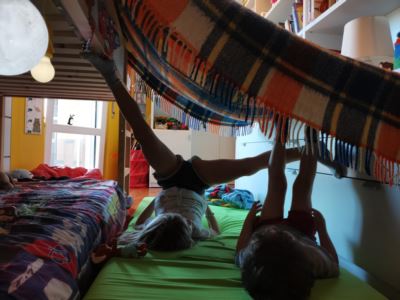
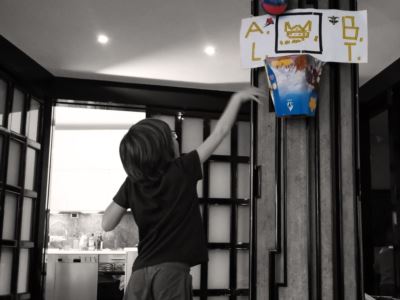
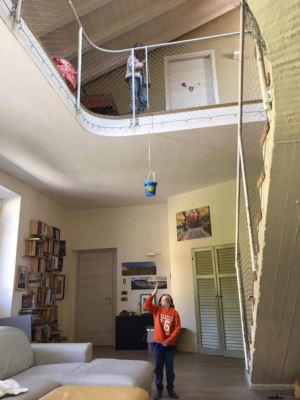
The idea was born from a fairly spontaneous game, that is, capturing everyday moments with our cell phones when we find ourselves using the house in ways we never imagined (in this, children are inexhaustible ideas). But the reflections went even further: which aspects of our apartment are helping us meet all the needs that are emerging, and which instead represent limitations? And what limits can we reinterpret by translating them into virtues?
 
From the photos received, many reflections and a kaleidoscope emerged on the most "inhabited" spaces during this difficult period.
Balconi
Balconies
 
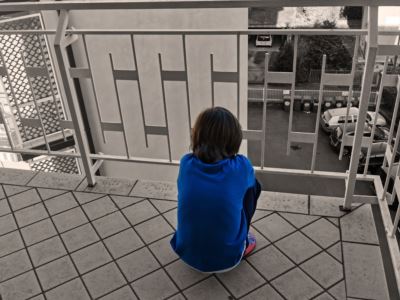
Balconies, literally “suspended”, are bound to the home yet projected outward. For those who could use them they became an essential opportunity to experience outdoors while staying inside. Yet in many housing solutions, balconies are narrow, uncomfortable, shaded, with railings that may be minimal in design but often not very safe.
Despite this, like theater balconies, they allowed some to still feel part of a world that was moving forward, even during the strictest lockdown periods.


Windows
 
Windows, vital openings in the outer wall, bring natural light and air into the enclosed space, windows also play the silent role to  maintain a connection with the outside world , acting like the eyes of the home. During lockdown, for many, they were the only point of connection—with other people, with nature, and symbolically, with the world.
Camere da letto
 
In most home layouts, the bedroom is the room furthest by the relationships spaces. A space reserved for rest and intimacy it is an exclusive area, especially for adults but also for teens. Parents’ bedrooms are conventionally off-limits for children's play. But ironically, during lockdown, this privacy made them the perfect space for smart working—shifting from a place of rest to a site of relentless work.
 
The kitchen and dining room represent the heart of the home: a space for hospitality, family, and togetherness.
like a kind of exponential formula, during lockdown they became the center of multiple activities, depending on the family’s needs, ages, and schedules, these spaces transformed continuously: classroom in the morning, relaxation zone in the early afternoon, play area, creative lab, or even gym later in the day, the living area of our homes knew no rest and no order for many weeks. We had to quickly let go of the ideal of perfection and formal appearance that we usually attach to this part of the home because of expectations shaped by past cultural norms. Who was Those who managed to do so were able to find many answers to the varied demands of being forced to live indoors.
Even corridors and passageways proved to be valuable. They hold no symbolic meaning in the traditional idea of "home"; their role is purely functional.
Yet precisely because of their lack of defined character, they became highly evocative spaces, especially for children’s play. For those who took the time to observe these dynamics, it became clear that a neutral space lends itself to infinite uses and when a neutral space meets a child’s imagination a whirlwind of possibilities comes to life
1

What reflections for the future?

Regardless of the emergency situation we experienced, and which, as designers, we wanted to observe precisely because it offered a valuable opportunity for reflection, what insight do we want to take from it, and help others take, especially those thinking about the future design of their homes?
 
A home has eyes, it has a heart, it is a living organism, not just a set of disconnected elements assembled for function and aesthetics.
Precisely because of this, it can form a virtuous synergy with the body and soul of those who inhabit it. We have seen this, it has been demonstrated to us. Could this vision perhaps be the starting point for restoring the identity between the individual and their living environment?
 
Design is an integrated and non-linear process, before reaching a final version, many scenarios are analyzed. Everything happens on the objective level of functional, technological, and cost-effective choices.
 
E’ an important piece that some designers often investigate, but the final recipient sometimes underestimates, with little incentive to expose himself to the point of truly questioning his own concept of home. Let's start by telling him that spaces can be fluid and show him these photos.